Three works record Commercial Street in three registers: two nineteenth century histories written while the town was still young, and one first-hand memoir of the street as it was lived. Click any PDF icon to open the full document.
Part civic history, part business directory, written by a man who lived there. History and Directory of Springfield and North Springfield · George S. Escott · 1878
Escott wrote while the town was still separate, still young, and still his own home; he had opened the first private school there himself. His chapter on North Springfield is part civic history and part business directory, introducing the founding merchants one by one: J. C. Jackson the grocer, H. H. Kaufholz whose store burned and who rebuilt in brick, the lumber dealers who mostly failed. It preserves the addresses given at the opening of the railroad in May 1870, and it records, plainly, how completely the town depended on the line: over half its citizens drew their pay directly from the railroad company.

The county historian’s fuller telling, written five years later and unafraid of the cost. History of Greene County, Missouri · R. I. Holcombe · 1883
Holcombe wrote five years after Escott and with more distance. Chapter 32 tells the same founding story with sharper edges, naming the refusal of the old town’s moneyed men to pay for depot ground as the reason North Springfield exists at all. He carries the account forward through the fires, the bank, the opera house, the churches and the lodges, and he does not look away from what the railroad cost the men who worked it.

A first-hand memoir that walks Commercial Street from memory, storefront by storefront. Commercial Street Through the Years · Irene Holly Cates · undated
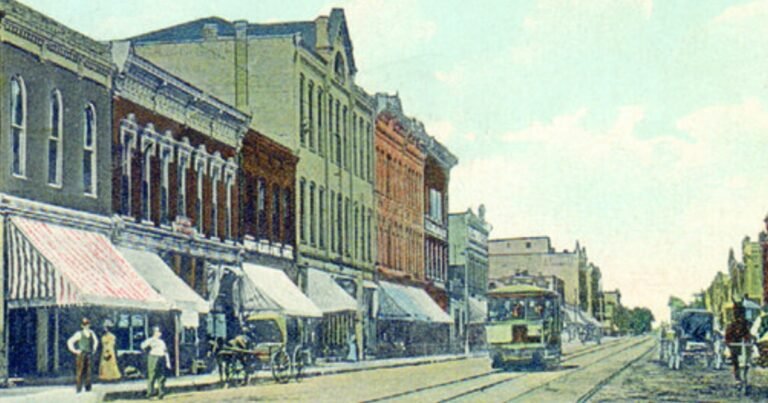
Neither a history nor a directory, but a memory. Cates walks the street as she knew it, beginning at Lyon on the north side and naming what stood where: the coal and feed yard, the grocery that gave away ice to the needy through the Depression, the fire station with its iron gray horses, the theaters, the drug store where a cone or a soda cost five cents. She is candid that recollection is imperfect. What she gives is the street at eye level, which no map or directory can.